Wednesday, December 25, 2013

Organisation of SUFI Phase 2 Home Visit in Cameroon

By Helen Ayamba, Email: camlink99@gmail.com 2,089,647 home visits will be covered by 4354 Community Health Workers (CHWs) throughout Cameroon during the second phase of SUFI. With SUFI Phase 2 strategy the target coverage is estimated to be about 80% of the households and all CSOs would have done at least two visits per year before December 2015. The number of Community Health Workers per district depends on the demographic weight. An evaluation of Phase 1 led to re-arrangement of the strategy for Phase 2. Pregnant women and children between 0 to 5 years constitute 52 % of the target population to be reached.
The community health workers will identify home with malaria cases to be handled with the support of the district health service. While Plan will send reports to the Global Fund, it will also assure the conception, definition and elaboration of the norms for execution of the programme.At the regional level, the CSO of the district sign and manage collaboration contracts at grassroots and funds for paying CSOs and CHWs will come from Plan International Cameroon. The role of the CSO is to carry out advocacy within the administrative locality and assure payment of the community health workers. The care delivery of identified persons during home visits is approved by the district CSO. A health community worker is expected to spend at least one hour for a home visit and has to accomplish at least two (2) homes a day. The community health workers selected were trained during the SUFI Phase 1 execution and these persons are well identified, of good morality, reside within the community and exercise subsistence activities. The community health worker will receive 350 CFA for every home visited.
M. Bahel Alain of the Malaria Unit at the regional delegation for public health in the Littoral made a presentation of what malaria is. Malaria is a major problem in Cameroon and many children die from its infection. This affects the economy of Cameroon and the use of MILDA and TPI is encouraged. He remarked that 66% of homes in Cameroon received LLIN, but only 39% make use the nets. This means that LLIN usage did not give positive results during 2012-2013 period. Participants were told that a mosquito can displace itself for a distance of two kilometers from where its eggs were laid and hatched. Within the context of behaviour change communication, at least 80% of pregnant mothers would be convinced to go to health facilities to receive their TPI, while CSOs supervise the activities of the community health workers. It is recommended that communication must be adapted to the context of the environment and in the local languages appropriate. One of the channels to be used is educative talks and the next technique is counseling, which helps a person to take a well informed decision on matters concerning health. A good community health worker considered as a person with an appreciable attitude, is welcoming, respectable, polite, attentive to the reactions of the population, available at all moments, well organized, dynamic and courteous. A health worker should have a good base of communication and master the health issue in question, use simple language, get people to participate in the community health actions. He or she should assure the family head to make sure that the pregnant woman and children sleep under a LLIN, because it is valid for at least three years. Once a pregnant woman is discovered, she should be advised to visit a health facility for consultation and protection of herself from malaria after rapid diagnostic test. When a child’s temperature goes high, the child should be taken to the community health worker or the nearest health facility. To carry out a home visit, the community health worker makes an action plan of homes to be visited and get the plan validated by the SUFI CSO. On introduction into a home, he or she should greet the persons met and thank them for being available as a means to establish confidence and create a friendly environment for counseling.
Before leaving, the community health worker should ask questions to verify if the SUFI message was well understood and take an appointment for a next contact. CHW are reminded that In the case of counseling, such a meeting is with one or two persons, while a counseling session is at least 30 minutes. The CHW is paid based on the number of visits done by the end of a month. The CSO will have to verify the content of the message left in the home visited and that the message is positive. CSO has to identify the infringements and find ways of correcting situations found on the field. He has to guarantee that the message is given to the right persons or target. Make appointments and precise fix time for the appointment which permits good exchange. CSO are also charged to undertake advocacy campaigns with the support of the local authorities and community leaders. The two axes for advocacy include lobbying and negotiations. Lobbying will involve the SDOs, DOs, Mayors, religious leaders and the traditional leaders. During contacts, the CSO precise the type of support needed from the authority. He will always write a message of thanks to the persons who assisted y during the field work. The CSO should be able to identify the community health workers of the district, their names, place of residence, and date of birth. The CSO will accompany the community health worker to the area of territorial coverage zone to avoid double tasks in the same zone. CSO support CHW in the making up of their action plans. Every community health leader has to limit his work within the attributed zone. The community health leader has a report and action plan to submit each month. Organisation of SUFI Home Visit Tchana Eric after giving room for comments and exchanges, presented a paper on the house count., focusing on the objective for the home visits and head count, target homes, the usage of the house count cartography. The CSO have to master the strategy of house count. The home visits have to target the pregnant women and children below 5 years. The house count aims at determining the geographic area of the targets of the homes having pregnant women and children below 5 years. The specific objective is to collect information about the persons in the homes counted. The exact number of persons living in the home has to be recorded. The community health worker will be paid on the number of homes visited. A home is any place where people live under the same roof with a family head. In a polygamous home, each mother and her children constitute a target group. A home can be headed by a man or a woman depending on the marital status. The home visits permit better supervision of the territory and facilitates control of the work of community health agents, especially as it would be opportunity to sensitize the target groups within the homes. Traget house count is expected to last 10 days. The exercise will cost CFA 30,000 per community health worker. 50% of the amount is paid at the beginning and the rest at the end of the exercise on reception and verification of the reports. An identification number has to be attributed to homes visited in a way readable and visible manner like this example: SUFI/MN001/Initiales ASC/VAD 01/ 2014. Follow up and evaluation At the end of the SUFI CSO training, the participants were able to explain what monitoring, follow up and evaluation and data is. The have a mastery of the tools for collecting data and the frequency of reporting the data collected from the field. It was explained that a follow up is a routine collect system of data of a programme or project which permit verification of the progress of activities. Community health workers have the role to collect data from the field during home visits. Data is measurable like numbers, distances, age, while qualitative data concerns sex and colour. The SUFI report should be able to show how activities were carried out. Indicators are variable quantitative and qualitative data used for measuring the manner of the objectives and results. The performance framework determines the indicators to be realized. An indicator could be the percentage of visits undertaken in a home with the number of children below 5 years and pregnant women IEC and BCC were carried out. The percentage of community health workers supervised for a example is also an indicator. The percentage of reports produced by the CSO is also an indicator of performance. Reports should be promptly transferred to the field supervisor before the 5th of each month.The CHW activities realized must be conform to the action plan validated by CSO regularly and these community health workers must respect their zone attributed to avoid duplication of the same activities in the same health areas and zones. The two key documents for follow up and evaluation are the identification forms of the homes and the data collection sheets on BCC. The community health worker may cover more than one bloc and the precise information of health areas covered should be mention in the data collection sheet to make the output visible.
The target home code does not changes throughout the project and collected data at during home visits is registered on the data collection sheets as follows: SUFI/MN001/TE/VAD1/2014 and SUFI/MN001/TE/ASC/VAD1/2014. Community Health Workers are not authorized to treat pregnant women during home visits. His or her role is to counsel pregnant women and refer them to the nearest health facility to receive the TPI after checkup. During the home visit, the community health worker register information on the subjects discussed, which include MILDA (1), TPI (2) and PECADOM (3). He should say when the discussion started and when the discussion ended to permit evaluation of the duration which must be up to 30 minutes at each home. The report from the CSO is a compilation of the reports from the community health workers in a health district including a financial report and a supervision report. Community health worker must transmit his or her report to the CSO by the 30th of each month and the report must be transmitted to the regional field supervisor by the 5th of each month. The regional field supervisor sends his report to the central desk at Plan by the 10th of each month. CSO has to validate the report of the community health worker before payment. The number of homes must correspond to the number mentioned in the action plan submitted by the CHW from the beginning. How the community health worker is supervised Supervision is a technical assistance from a top level authority to a person working in an organization. There are three types of supervision: •Facilitating approach (coaching and joint resolution of problems and communication in both ways). •Training supervision (Follow up of community health worker on the field and correcting errors noted in delivery during execution on the field. •Integrated supervision: supervision with participation of other stakeholders of different programmes. •The techniques of supervision consist of direct observation and exchanges during contacts. There is also the analysis of documents presented by the community health worker. •Organisation of auto-evaluation and to make constructive criticism on the work realized by the community health worker. This is done in a team and constitutes an internal evaluation. •Role of supervisor is to oversee the work of the community health worker. The supervisor helps the community health worker to improve on his performance on the field. •The supervisor has to promote team work, should be available, flexible and has humility, be ready to help others to develop, should be honest, credible and impartial, have the aptitude of good communicator, be attentive and give efficient feedback, should be a good manager of identified problems and have an aptitude of planning activities and carrying out a supervision. •In order to prepare a supervision, the term of reference document should be elaborated, which defines the objective, establish a calendar of supervision with dates, hours and venues to be visited. Elaborate a budget for the supervision. •The community health worker has to establish a cartography of the health area covered. •Prepare a mission order and get it signed by the supervisor.

Cameroon Link Engaged in SUFI Phase 2 Project

By Helen Ayamba, camlink99@gmail.com
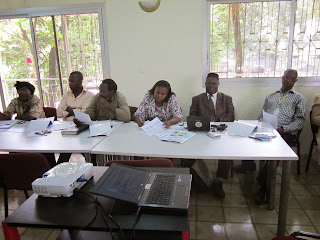
Cameroon Link has been engaged by Plan International Cameroon to participate in the coordination of the second phase of the Scaling Up of Malaria prevention for impact (SUFI) in the health district of Dibombari in the Littoral region of Cameroon. The collaboration agreement was signed on the 18th December 2013 in Douala during a regional training of Civil Society Organisations (CSO) selected. The representative of the regional coordinator of the Littoral Malaria Unit, M. Bahel Alain, who launched the training, called on the 20 participants of SUFI to follow up the training in a way to relay the key note messages and information collected smoothly while on the field during the execution phase. He announced that the second phase of SUFI will last for two years in December 2015. Key facilitators during the training were Mrs. Valerie Ahouama Etamba, IRESCO SUFI Project Coordinator, and Mr. Tchana Eric, the Zonal Field Supervisor of IRESCO, who will control and coach CSO throughout the execution phase. He gave the practical modalities and guided the participants to build up the norms and expectations after designating the minutes secretary and time keeper. Mrs. Valerie Ahouama Etamba, IRESCO SUFI Project Coordinator, spoke about the objectives and awaited results of the training to capacity CSOs on executing phase two of SUFI. The workshop which was basically interactive with the exchange of experiences during the first phase of SUFI Project, led to consensus on how to handle infringements while on the field, after discussing the differences between the two phases. The target groups of current SUFI Project coordinated by IRESCO in the Littoral and South West region are pregnant women and infants below 5 years.
For this reason, a pre-test was conducted to judge the level of knowledge of the participants on malaria generalities, before a lecture on behavior change communication and advocacy. The Zonal Field Supervisor emphasized on the home visits and the technique of identification of the target groups within the homes. A key role of the SUFI CSO will be to manage the Community Health Workers already selected in all the districts concerned and this will involve monitoring and evaluation at least twice every months.The third day of the training was dedicated to project financial management. The Project Accountant presented all the tools conceived to facilitate management and these tools were tested by the participants to evaluate the level of understanding their content.During the presentations, it was noted that access in some health areas is often difficult, especially during the rainy season when road network become very difficult though the short distances to cover. The funds put at the disposal of CSO are during this period not equivalent to the popular demands of the transporters.Valerie Ahouama Etamba, Project Coordinator, SUFI IRESCO presenting the objectives and outcomes of the workshop covered issues related to the context, general objectives, project structure; program approach; role of actors; rationale of the number of CHWs; criteria for selection of CHWs. She made it known that the general objective was to train the CSO on management of staff and finances of the project.
Mrs. Etamba observed that the Global Fund Round 9 Malaria component coming to the end of Phase I, raised a couple of key challenges in the area of monitoring and evaluation (M&E), financial management and program management/implementation. These gave rise for the need to check and make strategic modifications for the second phase, particularly in the program implementation structure, the target population and the reduction of the number of actors. SUFI phase 2 program will remain of national coverage and it will be implemented in the 10 regions of Cameroon targeting particularly the vulnerable groups made up of pregnant women and children less than five years. It will be recalled that the title of the Global Fund Round 9-Malaria Project being implemented in Cameroon is “Scaling Up Malaria Control for Impact in Cameroon 2011- 2015” and the goal is to contribute in the reduction of morbidity and mortality attributable to malaria by 50% by the end of 2015.
It is believed that if the actors play their roles well, an increase to at least 80% of the use of LLINs in the entire population and particularly among children under five and pregnant women will be achieved. The activities will raise to at least 80% IPT2 coverage among pregnant women; treatment according to the national malaria guidelines will increase to at least 80% of malaria cases at all levels; while all actors will have reinforced management capacity within the National Malaria Control Program. The strategies includes acquisition and distribution of LLIN to the general population; making available SP to pregnant women at ANC; purchase and supply of ACTs to health facilities; appropriate BCC (mass media and IPC) to promote adhesion to the various interventions; while monitoring and evaluation will be regular at grassroots.Pregnant women and children less than five years are vulnerable groups found in 52% of households of Cameroon. This means that there are 2,089,647 households representing a population of about 10,866,170 persons by the end of the project to be covered.

Thursday, November 14, 2013

UNICEF PLEDGES CONTINUED IYCF SUPPORT

By camlinknews Email: camlink99@gmail.com
H.E. Daouda Guindo, Representative of UNICEF pledged continued infant and young child feeding support during the official launching of the WBW 2013 celebration in Yaoundé. Speaking on behalf of UNICEF, Daouda Guindo, said it was a pleasure that his organization joined all the other actors in the celebration of the World Breastfeeding Week. It is an occasion during which everybody, supports, encourages and promotes breastfeeding. It creates an opportunity to make the impact of breastfeeding visible and gives the people of the world to highlight that support for child survival. The theme of this year which is linked to mother support, he added, aims at drawing the attention of the public to the importance of mother support by the fathers and to inform the community on the efficiency of the key messages and to unite forces to achieve goals.
It is also an opportunity to encourage advocates of breastfeeding irrespective of the level of the interventions, while identifying focal points that encourage lactating mothers. The UNICEF representative told the government of Cameroon that if we have to successfully fight against malnutrition, more funding and engagement is needed, because breastfeeding is a capital human investment. Breastfeeding is another way of poverty reduction and the elimination of malnutrition. Daouda Guindo recalled that the last demographic survey shows that breastfeeding rate in Cameroon is only 20% and this is caused by the early introduction of other liquids and solid foods before the recommended age of six months. This tendency can be reversed if the family, community, work place, health facility and government circles’ interventions are intensified. The interventions must cover the periods before and after birth of a baby.
Breastfeeding is simple and less costly. It is baby’s food that cannot be replaced. UNICEF has made a substantial contribution for wider community outreach by signing a collaboration convention with the Federation of Cameroon Breastfeeding Promotion Associations (FECABPA). The financial assistance is destined for information and education of mothers, fathers and youths within communities throughout Cameroon. Another area of investment is the organisation of a breastfeeding caravan in the northern regions to involve traditional leaders and other stake holders.
Activities of the World Breastfeeding Week in Cameroon were extended to the 8th November 2013 to permit the key messages of support to breastfeeding mothers to reach all levels of the communities. He concluded saying that UNICEF is sensitive to all inputs and actions in favour of breastfeeding, as he expressed gratitude to the World Alliance for Breastfeeding Action, WABA.

Health Workers Called To Promote Breastfeeding

By camlinknews Email:camlink99@gmail.com
The representative of the minister of public health, Dr. Ondoa Mekongo, said the presence of WHO, UNICEF, Health workers, and civil society organisations at the official launching of the World Breastfeeding Week in Cameroon translates their engagement and love for the survival of children in Cameroon. He observed that the theme of this year’s celebration is an eye opener because only 2 out of 10 mothers breastfeed their babies within the first one hour after birth. 6 out of 10 mothers breastfeed their babies for the first time within the first 24 hours after delivery. Only 2 out 10 mothers breastfeed exclusively in the first six months after birth. This situation is preoccupying and calls for political action to reverse the tendency. If all mothers breastfed their babies normally, 1000.000 lives will be saved throughout the world. Breastfeeding encourages contact between the mother and the baby during several hours of the day and it is the best way for promotion of attachment. It helps the mother to express her natural love to the baby, laying the base for love relationship and confidence between the parent and the child.
The government of Cameroon has taken a number of actions to promote infant and young child feeding. These included the decree instituting the national code for regulating the marketing of breastmilk substitute, national infant and young child feeding policy, the decision to accord two breastfeeding hours for the working mother, just to name a few. This is proof of the government’s engagement to improve on the wellbeing, protection and human rights of child in Cameroon. Dr. Ondoa Mekongo recognized that these actions are realized with the support of international partners like WHO and UNICEF. However, he added, that much is still left to be realized in the area of breastfeeding and the nutrition of the young child in Cameroon. The current struggle is to increase breastfeeding rates and especially early initiation within the first one hour of the birth of a baby. The target is to increase breastfeeding rate to 50% by the year 2020.
He reminded health workers at all level of their specific roles for the achievement of the government’s objectives in relation to the promotion of optimal breastfeeding, the protection of expectant mothers and lactating mothers against marketing of breastmilk substitute influences that compromises well informed decisions of mothers. To achieve the objectives, the health workers have to be trained to be able to carry out the duties correctly and encourage mother to start early initiation of breastfeeding. Nurses should promote permanent contact between the mother and the baby at all moments during their stay in the health facility. Addressing the health civil society organisations, Dr. Ondoa Mekongo, encouraged members of FECABPA to remain united and prepare them to receive mothers within the community when they are discharged from the hospitals and clinic, so counseling can continue within the family and community circles.
The Cameroon government has put in place a new programme which is scaling up nutrition within global partnerships with international organisations from this year. The programme will include actions for the promotion of breastfeeding, fight against malnutrition, de-worming of children, fortification of foods at home through training of health workers and intensification of community level campaigns for social mobilization, information and sensitization. He ended by making a call for international support to the scaling up nutrition programme.

Welcome Address Of Prof. Angwafo During WBW 2013

By camlinknews Email: camlink99@gmail.com
Speaking on behalf of the staff of the hospital, he expressed gratitude for the choice of venue for the launching of the World Breastfeeding Week 2013 in Cameroon. He said, the regular visits and events testify the importance of the health facility. The Under Secretary General of the United Nations in charge of innovative funding visited the hospital ahead of the WBW 2013. Pr. Angwafo Fru III announced the theme of the event falls in line with the preoccupation of their conviction. The doctors, midwives and nurses planned sensitization and educative talks on the importance of breastfeeding, the techniques of breastfeeding, good start of complimentary feeding, neurologic development of the infant and prevention of malnutrition.
He thanked all the intervening actors who federated their actions to make the event a success. Special thanks went to UNICEF, ministry of public health and civil society health organisations present at the ceremony. He described the Gyneco-Pediatric health facility as a Baby Friendly Hospital, where all babies are given equal attention. The focus on the hospital is on the prevention of the transmission of HIV from the mother to the child and he wished that the celebration should not be seen as a punctual occasion only. He gives an opportunity to demonstrate the fact that breastfeeding protects babies for illnesses and permits excellent growth, while assuring stability of affection. Emphasizing on exclusive breastfeeding for the first six months, Pr. Angwafo said, breastmilk is the ideal food for the new born. He encouraged mothers to continue breastfeeding after six months up to 24 months and beyond, while introducing appropriate well balanced complimentary foods. He reiterated that it is a recommendation of the World health organization and Cameroon’s ministry of public health.
Breastfeeding, the director general concluded is the best start for the fight against malnutrition of infants, as he announced that all babies born in the hospital are breastfed.

Saturday, November 9, 2013

FECABPA Fait Le Bilan - SMAM 2013

Discours de Président de la Fédération Camerounaise des Associations pour la Promotion de l’allaitement Maternel,(FECABPA), James Achanyi-Fontem, à la cérémonie du lancement de la SMAM 2013 au Cameroun à Yaoundé, le 8 Novembre, 2013 La BMAM est partir, les hommes sont passes et les parole restent... Voici ceque le président de la FECABPA et Directeur Exécutive de Cameroon Link a observé pendant le lancement de la SMAM. Ce blog va presenter tous les declarations des acteurs.
Excellence, M. Le Ministre de la Santé Publique, Honorable Invités, Messieurs et Mesdames, C’est un honneur pour moi de prendre la parole ici à HGOPY au nom de la Fédération Camerounaise des Associations pour la Promotion de l’Allaitement Maternel (FECABPA), à l’occasion de la cérémonie officielle marquant le lancement de la 21ième édition de la SMAM. C’est grand jour est l’opportunité d’évaluer les activités depuis 2012, d’échanger les informations et de planifier des activités pour l’avenir. Excellence, Monsieur le Ministre de la Santé Publique, la FECABPA en profite pour remercier l’ensemble des acteurs qui ont pendant les douze mois passées, facilité la mission de notre réseau qui intervienne dans le secteur de la santé en milieu communautaire. Considérant que la FECABPA fait partir du Groupe de Travail d’Hommes de WABA pour le soutien aux mères (WABA Men’s Working Group) et que c’est le Cameroun qui tient la place de leadership du Groupe Mondiale, nous avons participés à la conférence mondiale de l’allaitement maternel qui se tenue à New Delhi en l’Inde du 6 au 9 décembre 2012. Le Bureau du Réseau IBFAN Africa en Swaziland nous soutenu pendant cette participation après le passage de la Coordinatrice Régionale, Mme Joyce Chanetsa, au Cameroun pour l’évaluation de la tendance de l’allaitement maternel au Cameroun.
Depuis la première et deuxième évaluation de la tendance de l’allaitement maternel effectuée au Cameroun en 2009 et 2012, il y a eu une grande évolution : le Ministère de la Santé Publique a mise en œuvre des stratégies qui vise à décentraliser la gestion des activités et à y impliquer tous les partenaires et acteurs de tous les secteurs pour l’atteinte des Objectifs Millénaire de Développement (OMD 4 et 5) pour la réduction de la mortalité infantile. Pendant 21 ans, le Cameroun a participé à la Semaine Mondiale de l’allaitement Maternel comme tous les autres 172 pays à travers le monde entier; et le Cameroun fait partie des 45 pays qui ont évalué la tendance de la nutrition infantile et de l’allaitement maternel, entre 2009 et 2012; Nous notons aussi, Excellence, que le Cameroun est l’un des premiers pays à avoir un code national pour la protection de l’allaitement maternel depuis 2005 et ce code est l’outil qui régularise la commercialisation des substituts du lait maternel dans un pays. Nous profitons de l’opportunité pour remercier l’UNICEF d’avoir reproduit 10.000 exemplaires de notre code cette année. Ceci démontre l’intérêt et l’importance que le Cameroun accorde à cet évènement qui se tient aujourd’hui. La FECABPA opte pour un dialogue constructive pour amener les acteurs a adoptés un changement de comportement en faveur de l’allaitement maternel. Nous collaborons avec les différentes intervenants pour développer les nouvelles stratégies pour la réussite d’un bon allaitement par les mères en ce moment que le pourcentage reste faible. Les chiffres nous interpelle de prendre le temps de faire un regard aux années qui viennent de passé, confirmer les engagements à utiliser les différentes techniques de mobilisation sociale et les différentes approches adaptées au contexte du Cameroun pour sensibiliser nos mères, pères et jeunes.
Le rapport de la première conférence mondiale de l’allaitement en l’Inde a été partagé avec le ministère de la sante publique, UNICEF et autre intervenants. Pour l’avenir, la FECABPA va renforcer l’utilisation des outils et de canaux efficaces tels que les groupes de soutien des mères, les groupes des soutiens des pères et jeunes pour transmettre les bon messages de la nutrition de nos enfants. Les causeries éducatives sont organisées sur la bonne alimentation de nos enfants. 44 associations et plus de cinquante radios communautaires sont impliqués cette année avec l’appui du Ministère de la sante publique, l’OMS, UNICEF, WABA, IBFAN et autres. His Excellency, Our Esteemed and respected Minister of Public Health, FECABPA would like to use this opportunity to express its thanks and gratitude for all the wonderful changes made with the strong involvement of FECABPA in the piloting of community outreach activities throughout Cameroon from this year. Our members have requested that in my capacity as president of our network, I should express their sincere thanks and gratitude to you and your entire governance team. This translates the confidence the government attaches to mutual collaboration and responsible action for the promotion of the wellbeing of our communities. In 2012, we reached over 42.000 mothers through interactive community radio programming and the good news is that, we have been invited to attend the 7th Pan Commonwealth of Learning Forum (PCF7) in Abuja, Nigeria from the 2nd – 6th December , 2013. We would like to appeal to His Excellency, Minister of Public Health, to support the participation of FECABPA at the next African Regional Conference of IBFAN scheduled in Kampala, Uganda in August 2014. IBFAN Africa has made a call for greater involvement of youths in the breastfeeding movement, following the regular increase of teen mothers in our societies today, and Cameroon has to do something with the youths.
Community radio story design programming on mother and child health care in Cameroon has intensified, youths and the handicapped are having their voices heard in different programmes, because they too can make a difference. His Excellency, the Minister of Public Health, with this, we pledge to continue to serve within the rules and regulations put in place by the government through your ministry. We thank the ministry of public health, WHO, UNICEF, WABA, the Commonwealth of Learning, IBFAN, Nutrition Institute of Africa for the continued support, for us to play our role in promoting mother and child health care in Cameroon. Have a nice celebration and Thanks for listening.

Thursday, November 7, 2013

UNICEF Trains Journalists on IYCF Reporting

Helem Ayamba, CAMLINK News Email: camlink99@gmail.com
Some 25 Cameroon journalists and Foreign news correspondents attended a one-day workshop on health reporting focused breastfeeding, infant and young child feeding, hygiene and sanitation. The workshop was coordinated by the head of the UNICEF Communication Unit, Laure Bassek. She was accompanied by Dr. Jeanne Ejigui, who coordinates Young Child Protection activities at UNICEF Cameroon, Claire Soppo of UNICEF C4D unit and two senior health techincians from the health promotion department of the ministry of public health, Mahop Esther and Mahamat Ngede Marlyse. Presentations centred on briefing of journalists on the theme of the World Breastfeeding Week 2013 theme focused on breastfeeding support, close to mothers. The received a run down on why the breastfeeding week is celebrated each year, the value and relevance of the theme this year with insistence of exclusive breastfeeding considering that the rate remains around 20% since 2006. The connection of mothers’ nutrition and breastfeeding, principal activities organised in Cameroon with a breastfeeding caravan taking off on the 18th November to the 4th December covering four regions of Cameroon, East, Adamaoua, North and Far North concluded the training sessions. These regions of Cameroon have acute maternal and infant nutrition problems of different categories. Claire Soppo to participants at the workshop that the caravan with focus on the involvement of the tradition leaders, administrative authorities, nutrition NGOs and health delivery agents on the challenges of malnutrition promotion in Cameroon and the best practices. The reasons for involving the traditional leaders, Claire Soppo explained, is because they understand the culture of their communities, they are care takers of the traditions that influence political decisions that lead to behaviour change of populations. The traditional leaders have the power od persuasion of the communities and have the support of the populations. The participants will be guided during the caravn on the advantages of adaptation of essential family positive practices, mobilise proximity community radios to produce at least three programmes with the participation of all the stakeholders mentioned above as a community learning process.
The local authorities will be sensitised on how to prevention malnutrition within their jurisdictions through the promotion of good practice, hygiene and sanitation. At the end of the caravan, each traditional leader, administrative authority, senator, parliamentarian, municipal councillor and leader of civil society organisation would be required to mobilise the population at different levels to get involved and adopt good practices through special interventions. In a presentation prepared by Dr. Jeanne Ejigui, it was said that the world breastfeeding week is an opportunity to support mothers to practice optimal breastfeeding of their babies. It is also an opportunity to furnish peer educators with appropriate relevant information on the protection, promotion and support of breastfeeding. The key messages from UNICEF were shared with the journalists before an exciting and very instructive session on the the national code on the marketing of breastmilk substitutes in Cameroon. The journalists laude the effort of the government through the ministry of public for putting a place a national code which could serve as a tool for monitoring trends, The same journalists regretted that the Cameroon national code is toothless and needs to be improved on. On violations, it was observed that rampant incidents have been reported but unfortunately, Cameroon lacks a monitoring institution that could report violations and even follow up infringements in court. As a final observation, it was recommended that Cameroon is a bilingual country and needs to publish an English version of the national code when the contradictory articles would have been revised and a ministerial order of application signed and published.
In a concluding remark, the President of the Federation of Cameroon Breastfeeding Promotion Associations, FECABPA, James Achanyi-Fontem lauded the openness of the participants in highlighted witnesses in the Cameroon government strategy, while requesting that they should not loss hope, because change is a gradual process. He called on the journalists to become the market watch dogs and paly the role of code monitors, because the government and formulae productions companies have humane staff composed of fathers and mothers also. He ended by telling the journalists that exclusive breastfeeding is a child right which must be respected by mothers. The workshop was inscribed as part of the activity sheet of the Federation of Cameroon Breastfeeding Promotion Associations, FECABPA. After the training, a last tripartite session grouping top level authorities of the ministry of public health, UNICEF and FECABPA administrative council was organised to exchange on the platform of collaboration.